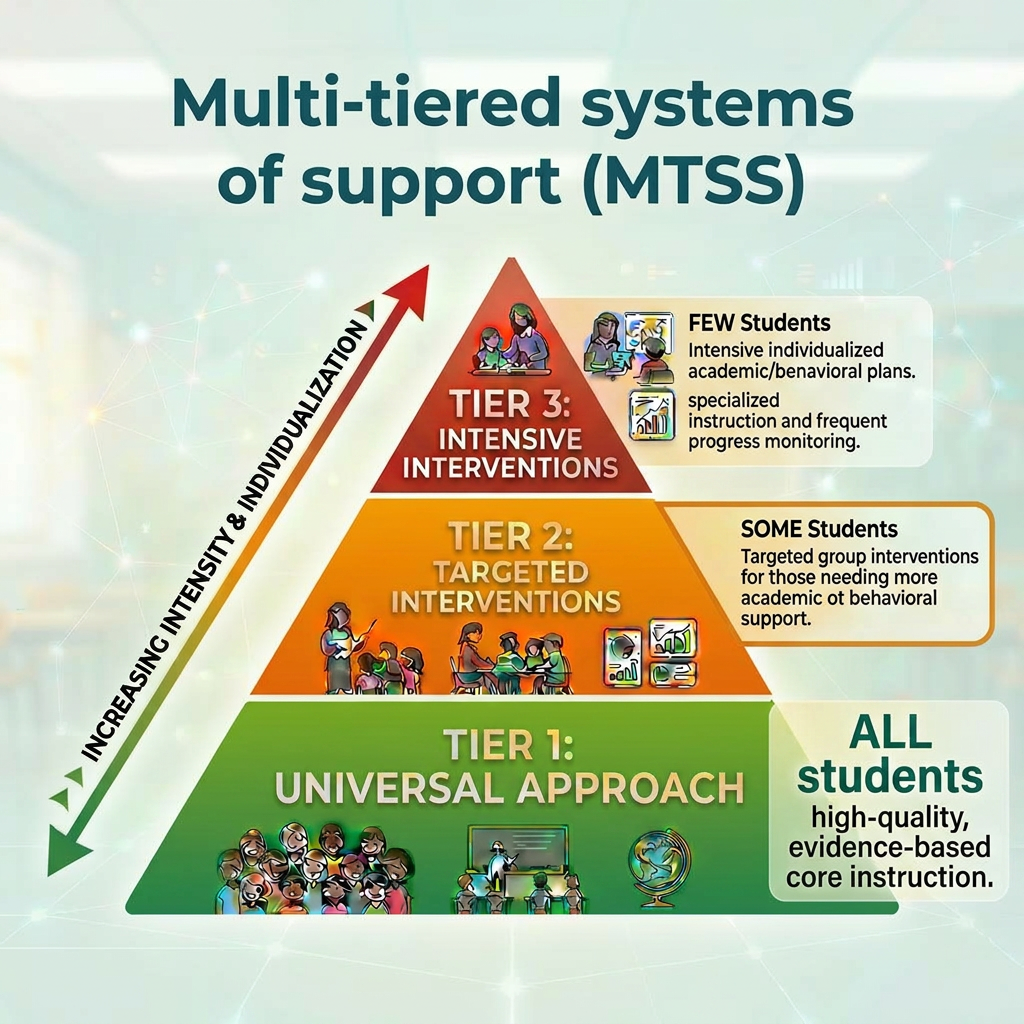
A teacher recently shared her frustration at her school’s decision to dismantle multi-tiered systems of support (MTSS) for various reasons, one of which she suggested was staffing constraints. When I first started teaching 40 years ago, concepts of MTSS and RTI weren’t really in my vocabulary. Today, I can’t imagine any school system that genuinely supports all students, not working within this system of support (even if they don’t use this terminology).
The concept of putting MTSS into place really took off during my role in my last school almost a decade ago when inclusion became our big work. In my setting, almost 70% of students were EAL/D with a high proportion of refugees. Of course, we also had our fair percentage of students with disabilities. All these students were taught within classrooms with their peers, and supports were an add on within the system. There can be no doubt that inclusion, especially at this scale, cannot work without MTSS and its supporting system RTI (Response to Intervention). When I talk about inclusion, I refer to the right of every child to be educated along with others in the same space as their peers. A classroom teacher is therefore possibly teaching students with a huge range of varying needs. This has to acknowledge the fact that not all students fit the same mould – and adjustments have to be made to enable all these students to access learning.
While my most recent experiences was with utilising the MTSS system within a fully inclusive space, I recognise that there are a number of educational settings that do not follow this model of inclusion. This would not negate the importance of addressing the needs of all students to access learning. How this supportive structure is established will differ slightly – but should still exist if the needs of all students are to be met with equity in mind.

Anyone who is intending to take inclusion seriously must put in place a multi-tiered system of support to ensure it is successful. It is only through the establishment of efficient supports within each tier of the system that the needs of all students can be met. The graphic above illustrates what most of us understand as the tiers of support in MTSS. I’ve removed the traditional percentages that are normally seen in such a graphic simply because, as I found within a high needs school such as mine, these percentages didn’t fit at all. And it is easy to get hung up on such percentages – and ignore the real needs of students.
In an inclusive setting, a classroom will possibly have a range of students with language development needs (EAL/D students), learning disabilities, behavioural and mental health needs for which supports must be put in place. In some schools, there might be perhaps 1 or 2 students in the classroom who need the kind of differentiation called for to support them. There are schools however that have a huge percentage of the class who need this support. I categorically put forward that is unreasonable to expect a teacher to meet these needs on their own.
At the heart of the debate on inclusion, and the various interpretations of the term “inclusion” lies the student. I have been in the middle of some very heated discussions about this. Here are two issues that should be considered in this debate.
High Expectations
I believe that at the heart of education there must be high expectations for all our students. This concept of high expectations is sometimes misconstrued. We are not saying all students must aim for high academic scores or to aim for a university pathway. We do expect however that a student will have the opportunity to realise and develop their potential. The reality is that often, within segregated settings, students and teachers do not work in the kind of environment that will allow students to see what their potential is. This could arise when students only have the opportunity to engage socially and academically with peers within a similar low socioeconomic backgrounds. This could arise when student’s do not have exposure to the aspirations possible in the world outside their family’s or community’s experiences. And this could arise from seemingly well meaning educators who dumb down the curricula because “the student’s are not capable of more”. (My quote because this excuse was given to me by my son’s teacher. My son could do more – he reached his goal of being an engineer despite the negativity he was steeped in).
While students studying with their age appropriate peers can raise their own expectations, many students will require support to reach standards that may be out of their reach. This is where MTSS comes in. School should not be a space where students and teachers see limitations. School must be a space where the education environment can identify what supports students need as they grapple with barriers that stand in their way.
In the inclusive classroom where students are not streamed into ability groups, students have a chance to work in the space of high potential, able to see what is possible. Studies have shown that the social environment of the classroom does have an impact on their self perception, the behaviours, and their cognitive and academic development. However, if the supports are not put in place, students will begin to consider that they are not capable enough to reach these goals. If support is not provided in the tier 2 and tier 3 level, students will be left behind.
The BArrier of low self esteem
Constant failure to attain age appropriate benchmarks will only lead to low self-esteem amongst students. There is no question that a student with a learning disability or a newly arrived refugee will need the support to develop skills and knowledge that stand as a barrier to performing at the level of their peers. When students see only the barriers, and cannot find a way to overcome these, it leads to low self- esteem and the belief that they are incapable of reaching higher levels.

There is an image that is seared into my memories from one of my walks through classrooms. While the teacher stood teaching in front of the engaged classroom of students, in the centre of the room, sat a refugee student who had arrived about 5 months before. She sat alone (while all other students were in groups). As I walked in she looked at me with a despondent look on her face. She could not understand the teacher (she was on a bandscale 2 at the time), and her days were filled with 70 minutes of these experiences when placed in a classroom where supports were not provided. How does a child, faced with such experiences, keep up the strength of belief in her own possibilities?
In high school, it is imperative that tiers of support are put in place to catch students before they fall through their gapping cracks in prior knowledge and skills.
Further Reading
This article by Matthew Tragheim discusses the difference between how the MTSS structure based on the Finnish and Greek models support in the inclusion space. What interested me in this article was how the impact on teachers will differ depending on the structure that is established.
2. Palardy G J . (2013, August). High School Socioeconomic Segregation and Student Attainment. American Educational Research Journal, 50(4), 714-754.
The data used in this study shows the close relationship between socio economic status and the outcomes for our learners. While there are many contributors to this highly complex issue, lower resourcing is one contributing factor. There is also evidence of the “less rigorous and less academically oriented curricula” (pg 721). When language learners, especially refugees, enter the school system in high school, they can get lost in a inclusive space that does not provide supportive structures.
3. https://theconversation.com/is-this-really-fair-how-high-school-students-feel-about-being-streamed-into-different-classes-based-on-ability-180965 (accessed on 30th July 2026)
This article in the conversation shares research that demonstrates the effects of streaming students. Many in the education field would choose to go down this road – it is far easier to establish a system where all students are almost alike in needs (streamed classes). It is far harder to build systems that place students at the centre and provide them with the supports they need to allow for equity in educational options.
Share your thoughts!